


The first time I saw a stranger’s corpse was one summer night in 1992, in a small, trash-filled courtyard in front of an abandoned building. I was 20, a cub reporter—an intern, really—for the San Diego Reader. One of my beats was supposed to be homelessness, because there was enough to go around for even an intern. But this wasn’t a story, just a body. A pair of cops stood watch, waiting for others who’d actually lay hands on the matter: white male, middle-aged, belly-down and facing away. Probably an OD, one of the officers told me, or maybe just a heart attack. “Six of one, you know?” he said. I didn’t, but I nodded. I was learning.
The Reader was a fat, tabloid-sized weekly paper, one of the biggest in the country at a time when not just the Village Voice but Washington, D.C.’s City Paper, Denver’s Westword, Chicago’s Reader (inspiration for San Diego’s), Philadelphia’s Weekly, Boston’s Phoenix and many more gave voice to and helped shape a way of thinking about cities: messy, thrilling, sad, funny, queer, glorious, pompous, comically crooked and endlessly fascinating. I arrived at the Reader the summer after my sophomore year of college because my creative nonfiction professor—we called it literary journalism then—had asked them to find a desk for me, after they’d asked him to fly across the country to write a cover story. Take as much as space as you want, they told him (14,000 words!), take as long as you want. We’ll handle all the expenses. The money will be good.
My teacher, Michael Lesy, was best known for a book called Wisconsin Death Trip; the paper’s idea was that he might like to move into the aging Hotel San Diego, said to be haunted, even as it was shined up—sanded down and made over in the colors of Hotel Anytown—for orthodontists and HR managers drawn by the new convention center. Michael didn’t believe in ghosts, but he believed in ghost stories. He stayed at the hotel, spoke with its residents and its staff, listened to tales of the gay pornographer who’d once owned it as well as the Pussycat Theater, and who they believed still made his spectral presence known.
These were, he knew, also stories about how a place changes, stories about “development,” about real estate, about different ideas of what it might mean to be “downtown.” “The Convention Center,” wrote Michael, “the bottom line. Cash flow problems. Overcapacity.” Those who still clung to their jobs at the hotel—which would soon enough follow the Pussycat into dust—spoke of its decline in terms of the supernatural. “Stories were distorted in transmission,” Michael wrote…
…but there was more: the ghost stories weren’t just the result of poor communication. The hotel had been stripped of its special identity. It had become a barren place. Interchangeable with a thousand others. Question: if human beings are confined to barren places, cells or stalls or cubicles, what do they do? Answer: they scribble on the walls. That’s what those ghost stories were: they were graffiti. They were the natural reaction of human imaginations to the pastel walls of an empty place. The ghost stories were decorations. They were efforts to transform the emptiness.
Maybe that’s what the alt-weeklies were, too. “Alt” was short for “alternative,” as in alternative to the daily newspapers published by men and women too often indistinguishable from the establishment they covered. Call it the franchise class: a political arrangement of lobbyists and electeds and suburbanites who demanded downtowns “cleared” of all that might make a tourist uneasy; replaced by chains, outposts, corporate colonization from the generic everywhere. The alt-weeklies, though, were made by people who loved their cities as cities.
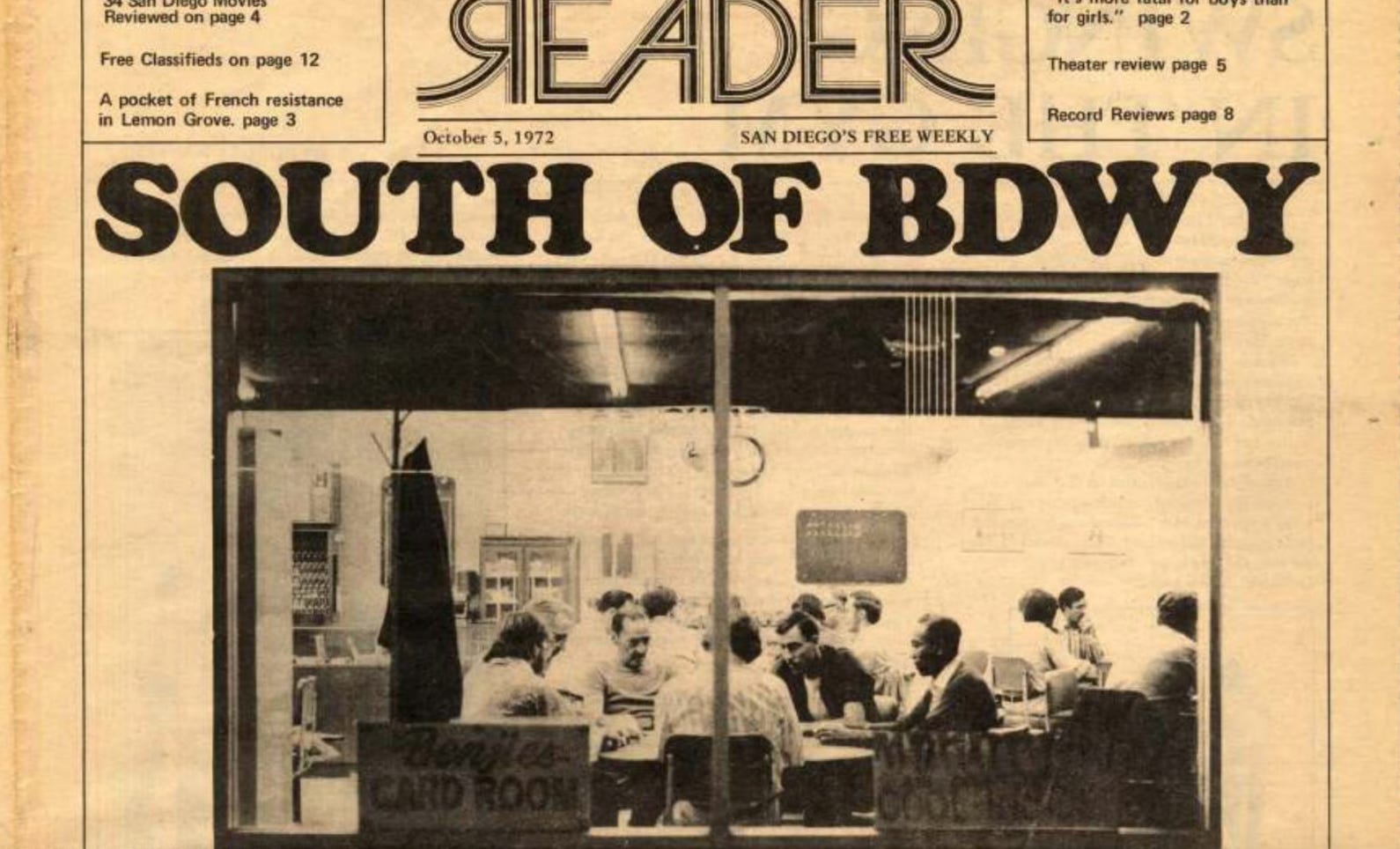
The first issue of the Reader featured on its cover a double bill under a single headline, “South of Bdwy”: one story of what San Diego would become and one of what it really was and had been. The first story, by a writer improbably bylined John Milton, followed the money fueling a re-development scheme; the second, by Nancy Banks, wandered among that which would be lost, the pool halls and the tattoo parlors and the strip clubs, the seedy ecology of a downtown defined by decrepit residence hotels.
The twinned tales were the origin story of the alt-weeklies: one part muckraking, aka the gap between what is and what should be; and one part simply what is, for better and worse.
Above the neon that remained, Banks wrote,
in two-dollar rooms with a sink in one corner and a long walk down the hall to the john, lonely men are spending another night staring at red and blue reflections on the ceiling. Golden West Hotel: the name itself is a mockery, a lurid joke…
But it wasn’t all noir. Allow me to quote at length from the cover story of the fourth issue, November 2, 1972, by a writer named Melanie Stutz. It’s about a roller rink. The piece as a whole is fine, but these three paragraphs?
There are skaters and skaters with big angular thrumming bodies and skates that you can feel rolling across the small bones of your feet. They are all skating forward. It is a hawklike kind of skating, very slit-eyed and predatory. All around the edges are young bruised-eyed girls with clinging purple and red and green jersey shirts and hip-hugger pants, lighting up cigarettes and thinning their mouths. The boys are lank-haired and craggy faced and they pose, and thrust their legs in snazzy stopping turns. In the middle of the ceiling there is a grinning jack o’ lantern with black and orange streamers strung around him.
There are some weavers in this clanging throng; people who are skating skillfully and using themselves like serpents, coiling in and around, insinuating themselves through the aimless boundings of most of the crowd. One very tall black man with legs like filaments bends and twists through the skaters, his arms hang behind him, thumbs gripping his pockets. And a serene old man in a sweater vest and flannel shirt, with richly polished black roller skates, ambling around the rink with his blue eyes half-shut and his face folded in calmly.
His name is Mr. McElroy, and he’s due to retire in December. He’s skated this rink since it opened, and he’s been skating since he was five. Back in Providence, Rhode Island, where he comes from, he used to play Roller Polo, in 1917 or thereabouts. Five men, with shinny sticks, which are scoop-ended sticks like hockey sticks, and a fat rubber ball. And he played hockey in high school. There was always, in the winter, ice eight inches thick and you could skate forever. “Skating’s great, it is. These skates I have, they’re real fine. They don’t make ’em any more. Chicago Velvet Treads. I have to be very careful with them. New, they’re about a hundred and ten. I got them barely used, for just seventy-five dollars, from a boy who’d been to Viet Nam and lost both legs.”
Maybe it is all noir, after all.
Unlike most of the alt-weeklies, the Reader was never bought up and hollowed out in the late ‘90s & early 2000s by corporate media chains. But like all the alts, it was gutted by the internet, by Craigslist, by the loss of the personals and ads for escorts and 1-900 numbers that paid actual money for writers to write 14,000-word cover stories and hang around in roller rinks. It held on in print until last year, though—no other way to put it—diminished in past decades by thinning ad pages, changing politics, the long victory of the re-developers. Its archives are online. I’ve spent part of this summer reading through them and those of other alt-weeklies—I set my window at 1972-2001—contemplating an anthology of this kind of increasingly rare journalism, literary journalism, the longform of lingering in a place just to see how it is.
And I’ve been keeping a partial list of how it was, topics covered. There were the local variations of mass phenomena and common callings: taxi drivers, coroners, night nurses, preachers, sewer patrols; gangbangers, psychoanalysis, pornographers, convents, massage parlors; real estate schemers, plastic surgeons, pawnbrokers; trash men, fish mongers, bail bondsmen, the boxing scene; the drag scene, drag racing, 911 operators; crooked cops, white supremacists, snake oil, bomb shelters, beekeepers, bookies; taggers, people who live under bridges, fox hunts; detectives, murder and suicide and sudden death (mortality tales), confiscated guns; professional shoplifters, RV salesmen, poker rooms, evidence rooms; the circus, bank robber confessionals.
And then there were the stories either specific to San Diego (or Tijuana), or particular to the Reader: urchin divers, gem miners, the mountain lion menace, mermaid strippers, lucha libre; Bible smugglers, Naval deserters; door-to-door funeral salesmen, whale burials, the tuna/porpoise debate, the black market military weapons trade, the black market baby trade, the down-low gay marine sex trade; a General Patton devotion society; bingo wars, bombing range scavengers, cross-border match makers, yacht rock con men; underwater birthing, hot tub rebirthing, van orgies, wild horses; Little Cambodia, the Vietnamese gang scene, the Laotian gossip rag scene; bullfight surgeons, brawling marines, courts-martial, surfer wars, shark hunters; politics in the nudist scene; the never-ending documentos chuecos trade.
***
Inspiration for this tribute comes not from San Diego but from Vermont’s Seven Days, one of the last and best alt-weeklies standing. For the most part the years of narrative reporting for the sake of narrative—what is rather than reformist examination of the gap between what is and what should be—are past, not just with the alts that are gone but in the shrinking feature wells of glossies, filled more and more often with perfectly worthy (but often dull) persuasive writing crowded with disembodied opinion. An exception—Seven Days publishes a number of fine exceptions—was l a 2025 Seven Days cover story, “Tent City,” by Derek Brouwer.
It’s about the unhoused of Burlington, a frequent topic in Vermont, a seemingly quaint state with the second or third highest per capita rate of houselessness. But instead of either fretting about needles on the sidewalk or defending the right to shelter—instead of another take—Brouwer follows Neil Preston, the urban park ranger tasked with supervision of the city’s tent population. Really follows him. On his rounds, down into the overlooked, overgrown corners in which the not-so-quaint reality of Burlington, Vermont, reveals itself. Brouwer’s prose is straightforward; so, too, is the simple courage he musters in following Park Ranger Preston:
Up ahead, a dog named Chopper awaited.
Within this dense stretch of woods that hugs the lakeshore, some campers have erected a sprawling compound using plywood and tarps. Spare wood pallets jut above piles of stuff: wagons, storage crates, a Vermont flag, pots and pans, hammers and nails, a bottle of salad dressing. The residents have stationed a portable sink up a set of stairs, next to elevated sleeping quarters. A Vermont Rail System sign warns: “Private Property No Thru Traffic.” Chopper, an unusually stout cattle dog, was enforcing that edict.
Chopper had sunk his teeth into Preston during one of the ranger’s earlier visits. Preston knew the dog had bitten others, too, and harassed a Canadian tourist.
The dog saw Preston coming up the path and charged.
“You’re going to need to get Chopper!” Preston yelled to its owner. But no humans were home.
The dog jerked at the end of its lead, baring its teeth and barking. Preston stood his ground. He reached for the pepper spray that he keeps holstered on his belt, worried Chopper’s lead might not hold, and squirted the irritant toward the ground. Chopper’s barks transformed into a whimper. “Get the fuck back in the tent,” Preston implored the dog.
Purveyors of takes will find plenty to feud over in this story. Brouwer’s sympathy, like Ranger Preston’s, is clearly with the people simply trying to stay out of the weather; this will anger the “quality-of-life” constituency. But Preston is nonetheless a kind of cop, charged with removing tents in response to anonymous complaints filed to an app ominously called SeeClickFix.
The the complaints come for Ranger Preston, too, from residents unsatisfied with the vigor of his enforcement. They want him to make the tents, and the people within them, disappear. To erase reality. To produce a fiction.
I mention this fact because even though I find myself on the side of mutual aid groups such as Food Not Cops, I like Ranger Preston—who, when compelled to deliver a “notice to leave” to one tent dweller, points him to another clearing that’d technically satisfy the law. I don’t want Preston to lose his job.
That’s how it is now: To read is to vote up or down. To summarize Brouwer’s story is to render the kind of basic observation he practices—once a weekly staple in alts across the country—nearly impossible. I can almost hear you, like me, staking out a position. The compression of social media has reduced narrative to instant opinion, sublimated curiosity to the needs of advocacy, and turned me into a curmudgeon shouting at the journalism of today to tell more goddamn stories. Why, when I was a boy…
Here's one more bit from the Reader, a man named Charles schooling a young writer spending Christmas Eve in a shelter, 1992:
“This boy a reporter. A YOUNG REPORTER. He wants to know about the shelter. How is it going? Where it is? WHAT IS IT DOING TO THE MINDS OF STREET FOLKS?
“Now, what to do with homeless folks? You got to be one.” His voice became grave. “We all grow up, homeboy. We all go through some terror, some horror, some nightmare, some thrill that just—” Charles ground his teeth together, making a low growling sound that stopped just short of a scream.
He held up his hands. The ends of his fingers tapered into gnawed stumps without fingernails. “I don’t bite these nails ‘cause I’m just worried. I bite these nails because it comes to worry itself…”
***
I wrote the above for a terrific newsletter from the Upper Valley of Vermont and New Hampshire called Daybreak, edited by Rob Gurwitt. If you’re in VT/NH, I can’t recommend it enough. If you’re not but you love the deep specificity of local news, it might be for you.
The specificity of local news: Readers of Scenes from a Slow Civil War may wonder what this post has to do with this forum’s titular topic. Here’s a little scene from The Undertow: Scenes from a Slow Civil War, a VFW in Layton, Utah, I ended up in after a meeting with a III Percenter militia leader fizzled:
Every barstool but one was taken. A TV droned. Men snoozed, folding themselves round beers gone flat and warm. It was two thirty. I sat at the empty stool at the end, kitty-corner to a white-bearded man in a Navy ballcap who was working his way through a giant mug of coffee and a stack of newspapers. He muttered. Column inches advanced. Bad news? Of course. I told him I was following the ghost of Ashli Babbitt across the country. I said it just like that. “Yuh-huh,” he said. He acknowledged that he knew the name, but his wide-framed glasses remained fixed on the paper.
“Fake news?” I asked.
He put the paper down and examined me. Then he picked it up and held it between two fingers, like a tissue. “No news,” he said. “The problem’s right there.” He gestured to the man beside me, lost in his phone. “We gave it all to those things, and we let our newspapers shrink till they’re almost nothing, and then we wonder why we don’t know anything.”
This scene is about the loss of news in general. Even at just their average, weekly selves, the alt-weeklies maintained an investigative intensity that showed readers how to be skeptical of power without collapsing into conspiracism. But even more important to me, the narrative stories I’ve been reading exemplified a culture of curiosity. The empty-calorie fulfillment of that curiosity with quick-hit Google searches, depersonalized Wiki expeditions, and, now, AI queries has quickened the collapse. The near-demise of the alt-weeklies didn’t bring on this slow civil war. Symptom, not cause. Maybe within that tradition, though, a notion toward a counter-intuitive response: rather than the direct rebuttal to fascism, sometimes the long, peculiar and meandering story about the oddness of the everyday which fascism seeks to sterilize.
A few gems from my summer alt-archive reading:
1. "The Boy Next Door," by Sue Garson, San Diego Reader, 1983. "True crime" that turns out to be a story by and about a single mother contemplating complicity and survival.
2. "Soldier's Paradise," by Mary Lang, San Diego Reader, 1989. To even say what this story is "about" misses the point: There's a sailor, an older woman, a bad marriage... it's the journalism of ordinary people getting by.
3. "Resurrection," by Robin Bingham, Washington D.C. City Paper, 2000. Another account of an alt-weekly intern finding a body. Only she knows how to write the story.
UPDATE: Many gems in the comments, but of particular note for my purposes is this, from This Woman Votes, who states the implications more powerfully than I could:
The death of alt-weeklies didn’t just kill a publishing model; it gutted the last public square where curiosity had the right of way. The corporate dailies sanitized the world until it smelled like hotel disinfectant, and the internet finished the job by selling off the bones to Craigslist and Google. What we lost wasn’t just longform stories about drag queens, roller rinks, and shady bail bondsmen — we lost the habit of lingering, of sitting with the mess of reality until it revealed something worth knowing.
Now, every damn thing is a “take.” Condensed. Opinionized. Algorithm-flattened until all that’s left is rage bait and a comment section war over scraps. Fascism thrives in that emptiness because it offers certainty where there should be questions, discipline where there should be curiosity. Alt-weeklies were graffiti against the blank wall of capital’s sterilized “redevelopment” projects. They taught people to ask: Who benefits? Who gets erased? And what’s hiding in plain sight?
That isn’t nostalgia, it’s strategy. If you want to fight authoritarianism, you need more than slogans. You need the peculiar, meandering, hyper-specific stories about the oddball texture of life - the very stuff the right wants to scrub out with power-wash morality. The long form of lingering wasn’t a luxury. It was democracy in print.
i raise my cafe mam thermos to the *Eugene Weekly* this morning. A still sweet little weekly in this university town, almost gutted about the same time corporate America trashed a belowed family-owned daily here. (All probably play a big unconscious part of why i'm such a crabby "90-year old white hippie' on-line.)
One thing that struck me when reading Tricia Romano's recent oral history of the Village Voice is that reporters, making little money doing what they loved at alternative weeklies, were able to afford to live in Manhattan. They discovered a lot of things that were happening (including Stonewall) simply because they happened to be walking around or sitting in bars.
That was the NYC I grew up in: a working-class city. I don't romanticize it. There were child prostitutes my own age working in Times Square when I was a kid, and that was horrible. I remember walking with my mom to the Port Authority Bus Terminal and seeing children who were single-digit ages with streaks of gray in their hair, already old from neglect, malnutrition, and abuse.
The city could have fixed itself without destroying itself. That’s what happened in Jacob Riis's time, when reformers made improvements without razing all that was good, and it could have happened again. The financial community getting control of the city after the mid-'70s financial collapse was part of the issue, but it doesn't tell the whole story. The cost-of-living increases weren't solely an NYC phenomenon. The same happened in most major U.S. metropolitan areas.
The decline can be traced to Ronald Reagan's savaging of the public housing budget by 78% during his second term. That was the beginning of normalizing the wildly unequal city, the gleeful demonizing of the impoverished in America. And the people willfully voted for it all, aware that their fellow citizens would get hurt. They kept doing it even when they realized they would also get hurt--and we've reached the apotheosis of that destructive impulse with Trump. Maybe that's what happens at the end of an empire? The majority want what amounts to a mean-spirited death cult. Or maybe Mamdani's rise means we could rebound? It seems unlikely, but we have to take hope where we can find it right now.